Study facts at a glance
Population and comparison: TRUST randomized 737 adults aged at least 65: 368 to levothyroxine and 369 to placebo. Mean age was 74.4 years; free T4 was within the reference range. Source 1
Blood-test response: Mean baseline TSH was 6.40 mIU/L. At one year, TSH was 3.63 with levothyroxine versus 5.48 with placebo. Source 1
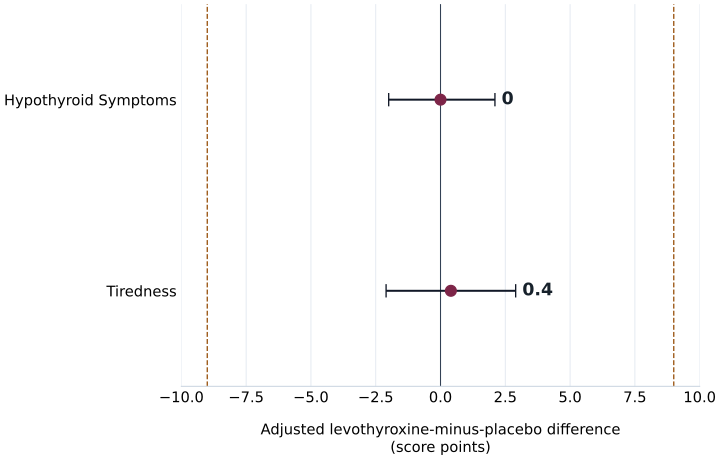
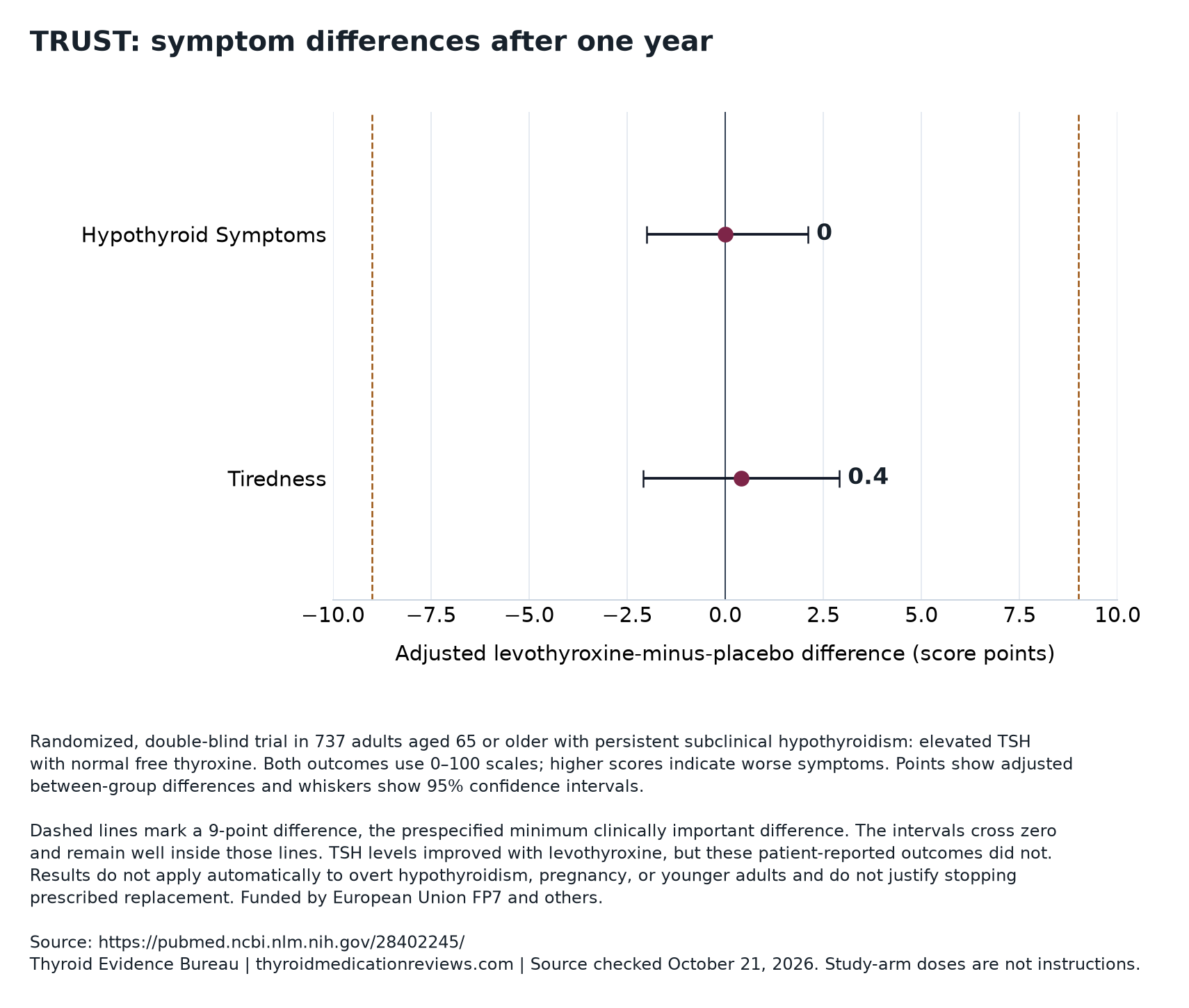
Primary symptom findings: Between-group differences were 0.0 points for hypothyroid symptoms (95% CI, −2.0 to 2.1) and 0.4 for tiredness (−2.1 to 2.9), against a 9-point clinically important difference. Source 1
Related analyses overlap: The 638-person symptom analysis reused TRUST data. The prospectively planned analysis of 251 adults aged 80 or older combined two trials and also included TRUST participants. Source 2 Source 3
Safety remains relevant: TRUST reported no significant excess of prespecified serious adverse events of special interest. Official levothyroxine labeling nevertheless warns about cardiac and bone consequences of over-replacement. Source 1 Source 4
The diagnosis defined the trial’s boundaries
Subclinical hypothyroidism is a laboratory-defined state: TSH is elevated while free thyroxine, or free T4, remains within the reference range. TSH is the pituitary signal involved in regulating thyroid hormone production. In TRUST, qualifying TSH values were 4.60–19.99 mIU/L, and the abnormality had to persist. This is different from overt hypothyroidism with low circulating free T4.
The average participant was 74.4 years old, and 396 participants, or 53.7%, were women. Mean baseline TSH was 6.40 mIU/L, with a standard deviation of 2.01. Although eligibility extended to substantially higher TSH values, the average was near the lower end of the permitted range. The abstract does not provide enough detail to estimate treatment effects specifically for participants at the upper end.
Consequently, the most direct application is to older adults with the kind of predominantly mild, persistent biochemical abnormality represented in the trial. It does not establish outcomes in younger adults, pregnancy, or people requiring replacement after thyroid removal. The guide to judging thyroid medication reviews explains why a diagnosis and enrolled population matter more than a broad claim about thyroid treatment.
Read the underlying chart data: download CSV or download the source-labeled chart.
Placebo and blinding protected the symptom comparison
TRUST was randomized, double-blind, placebo-controlled, and parallel-group. Randomization assigned participants to treatment or comparison groups; parallel-group means they remained in their assigned treatment strategy rather than crossing through multiple therapies. Blinding reduced the opportunity for expectations about receiving hormone to influence symptom reporting or study management.
The active intervention was daily oral levothyroxine, also called L-thyroxine or LT4. The reported starting study dose was 50 micrograms, or 25 micrograms for participants weighing under 50 kilograms or with coronary heart disease. Investigators adjusted treatment according to TSH. Placebo participants underwent mock adjustments, preserving the appearance of comparable management. These doses describe study arms, not a personal treatment protocol.
This comparator was essential because symptoms can change over time without a drug-specific effect. A before-and-after improvement in a treated group would not by itself establish benefit. The randomized contrast asked whether levothyroxine produced improvement beyond what occurred under the placebo strategy. Funding was reported from European Union FP7 and others; the abstract does not identify every additional funder.
TSH changed, establishing a real biochemical contrast
At one year, mean TSH was 3.63 mIU/L in the levothyroxine group and 5.48 in the placebo group. The median levothyroxine dose was 50 micrograms. The separation between the reported one-year means was 1.85 mIU/L, calculated by subtraction. This is a laboratory-unit difference, not a percentage-point change or a measure of symptom relief.
TSH also declined in the placebo group relative to the overall baseline mean of 6.40. That observation is another reason not to credit every change after treatment to the medication. The abstract does not establish why placebo-group TSH fell, and it would be speculative to assign a single explanation.
Editorial interpretation: the biochemical contrast strengthens the symptom finding. The comparison was not simply between two groups whose average TSH remained indistinguishable. Levothyroxine changed the intended laboratory marker, yet the primary symptom outcomes did not improve relative to placebo. The study therefore tested, rather than assumed, the link between lowering TSH and feeling better in this population.
The primary outcomes measured how participants felt
The two primary outcomes were one-year changes in the Hypothyroid Symptoms and Tiredness scores on a thyroid-related quality-of-life questionnaire. Each scale runs from 0 to 100, with higher scores indicating worse symptoms or tiredness. The report identified 9 points as the minimum clinically important difference: a benchmark for a change large enough to matter clinically.
For hypothyroid symptoms, mean changes were 0.2 points in both groups. The reported between-group difference was 0.0, with a 95% confidence interval from −2.0 to 2.1. For tiredness, mean changes were 3.2 with placebo and 3.8 with levothyroxine; the reported between-group estimate was 0.4, with a confidence interval from −2.1 to 2.9. Subtracting the displayed tiredness means produces 0.6, but that is not the report’s between-group estimate.
These are score-point differences, not percentages of participants helped. Both confidence intervals lie well inside the 9-point benchmark in either direction. The result therefore offers more information than a bare statement that statistical significance was absent: the estimated average effects were small, and the intervals did not approach the specified clinically important difference.
TRUST one-year primary outcomes: levothyroxine versus placebo
| Outcome | Reported between-group difference, points | Interpretation against the 9-point benchmark |
|---|---|---|
| Hypothyroid Symptoms | 0.0; 95% CI, −2.0 to 2.1 | Estimate centered on no difference; interval well within ±9 points |
| Tiredness | 0.4; 95% CI, −2.1 to 2.9 | Small estimate; interval well within ±9 points |
Averages leave individual variation unresolved
A confidence interval describes uncertainty around an estimated group contrast under the analysis assumptions. It is not a range within which every participant’s response fell. Individual changes varied substantially: the reported standard deviations for symptom changes were roughly 14–15 points, and those for tiredness changes roughly 18 points. Those standard deviations describe variation, not uncertainty around the treatment effect.
Some participants could improve while others worsen in either arm. What TRUST did not show was that assignment to levothyroxine shifted the average primary outcomes favorably compared with placebo. Nor does a group-average result supply a reliable method for identifying a particular person who would benefit.
The abstract also reports no beneficial effects on secondary-outcome measures, without giving enough detail here to reconstruct each endpoint. It should not be expanded into a claim that every imaginable thyroid-related outcome was definitively excluded. Questions about longer-term outcomes, distinct biological subgroups, and the higher end of the eligible TSH range require evidence beyond the reported primary symptom estimates.
Greater starting symptoms did not reveal an added benefit
A secondary TRUST analysis examined 638 participants with complete outcome data. It asked whether greater initial symptom burden identified a treatment-responsive group. High burden meant a baseline Hypothyroid Symptoms score above 30 or Tiredness score above 40. There were 132 participants above the symptom threshold and 133 above the tiredness threshold; these counts should not be added as if they necessarily represented different people.
Among participants with high symptom burden, hypothyroid symptom scores improved by 12.3 points with levothyroxine and 10.4 with placebo. The adjusted between-group difference was −2.0 points, with a 95% confidence interval of −5.5 to 1.5. Thus, the substantial improvement within the active arm was not evidence of a comparably substantial drug effect: the placebo group improved almost as much.
Tiredness improved by 8.9 points with levothyroxine and 10.9 with placebo; the adjusted difference was 0.0, with an interval of −4.1 to 4.0. There was no evidence that starting symptom severity modified treatment effects. This was a post hoc analysis with smaller subgroups and complete-case selection, not an independently randomized confirmation. The guide to persistent symptoms and normal thyroid tests addresses the broader review question without treating a symptom score as proof of thyroid causation.
The analysis after age 80 was planned, but not independent
A prospectively planned combined analysis focused on 251 community-dwelling adults aged at least 80, with a mean age of 85. It combined 105 participants from one trial with 146 from a second, including TRUST data. There were 112 assigned to levothyroxine and 139 to placebo; 212 participants, or 84%, completed the study. Planning the analysis prospectively distinguishes it from the post hoc high-symptom analysis.
At one year, the adjusted between-group difference was 1.3 points for hypothyroid symptoms, with a 95% confidence interval from −2.7 to 5.2. The tiredness difference was −0.1 points, with an interval from −4.5 to 4.3. Neither interval reached the 9-point clinically important benchmark, and neither estimate showed a meaningful average symptom advantage.
These results provide a more age-specific view, not a third wholly separate replication. Counting the main TRUST report, its symptom reanalysis, and this pooled analysis as three independent trials would exaggerate the amount of distinct evidence. Their value comes from asking related questions with different analytical approaches, while retaining awareness that some of the same participants contribute more than once.
How the three reports relate to one another
| Report | Population and analysis | What it adds |
|---|---|---|
| Main TRUST trial | 737 randomized adults aged 65 or older | Primary placebo-controlled estimate of one-year symptom effects |
| High-symptom analysis | 638 TRUST participants with complete outcome data; post hoc | Tests whether greater starting symptom burden identifies benefit |
| Age-80-plus pooled analysis | 251 participants from two trials; prospectively planned | Age-specific estimate, with partial overlap with TRUST |
Safety findings do not erase over-replacement risks
TRUST reported no significant excess of serious adverse events prespecified as being of special interest. That is a specific trial finding, not proof of zero risk. The indexed abstract does not provide the event counts and confidence intervals needed for a detailed assessment of how much excess risk remained compatible with the data.
In the age-80-plus analysis, at least one adverse event occurred in 33 of 112 levothyroxine participants, or 29.5%, and 40 of 139 placebo participants, or 28.8%. The difference between those reported proportions is 0.7 percentage points. These are overall adverse-event proportions, not necessarily drug-caused events, and their similarity does not establish equivalence or exclude rare harms.
Official Synthroid tablet labeling warns that over-treatment may precipitate angina or arrhythmias, including atrial fibrillation, particularly in older adults or people with cardiovascular disease. Over-replacement can also increase bone resorption and reduce bone mineral density. Its boxed warning states that thyroid hormones are not treatments for obesity or weight loss. The Synthroid label and claims review keeps those product-label facts distinct from TRUST’s efficacy question.
The three-treatment crossover study asked a different question
A separate randomized, double-blind crossover study compared oral LT4, LT4 plus liothyronine, or LT3, and desiccated thyroid extract in 75 people already receiving treatment for primary hypothyroidism. Their actual age range was 29–65, with a mean of 50. Each participant received each therapy for 22 weeks, approximately 66 weeks across three periods—not 22 weeks total or 225 different participants.
Overall primary outcomes did not differ across treatments. Exploratory analyses identified improvements on some measures among participants who performed worst during LT4 treatment, but these were not the primary powered comparisons. The full article acknowledges small subgroup sizes, many analyses, and possible regression to the mean. No adverse effects were reported, although mean heart rate was higher during desiccated thyroid extract treatment: 73.7 beats per minute versus 71.5 with LT4 and 70.4 with combination treatment.
The study was funded by Walter Reed National Military Medical Center’s Institutional Research Board. Its population, comparator, and clinical question differ from TRUST’s. A subgroup signal concerning formulation choice in established disease does not overturn a placebo comparison about starting treatment for subclinical disease. The full crossover-trial analysis examines that distinction in greater depth.
Keep trial evidence separate from product and service claims
TRUST did not compare brands, pharmacies, clinical platforms, or compounded products. Its result cannot establish the outcomes of a provider’s service or automatically transfer to another formulation or route. Likewise, official Synthroid indications for hormone replacement do not turn every symptom complaint with mildly elevated TSH into evidence of likely benefit.
Editorial interpretation: when evaluating a treatment offer, the key distinction is between a laboratory goal, a demonstrated patient benefit, and a contractual promise. A service may describe testing or follow-up, but the existence of those activities does not establish a symptom outcome. The treatment price-quote guide provides a separate framework for documenting what a charge includes; TRUST supplies no cost-effectiveness estimate.
For documentary terms rather than implied treatment results, readers can consult the CoreAge Rx review and CallOnDoc review. Those links do not imply that either service offers the studied intervention or condition-specific care. Decisions about thyroid treatment remain individual clinical decisions; this trial is not a starting, stopping, or dose-changing instruction.
Questions about the evidence
Does TRUST show that levothyroxine does not work?
No. It showed that levothyroxine lowered TSH without improving average thyroid-symptom or tiredness scores relative to placebo at one year in older adults with persistent subclinical hypothyroidism. That is a narrower finding than failure of hormone replacement. Overt hypothyroidism, thyroidectomy-related replacement, pregnancy, and younger populations were not the clinical question tested.
Could a symptom benefit have been missed because the trial was too imprecise?
The main primary-outcome intervals were relatively narrow: −2.0 to 2.1 points for symptoms and −2.1 to 2.9 for tiredness. Both were well inside the specified 9-point clinically important benchmark. That argues against a large average benefit on those scales, while leaving individual variation and effects in inadequately characterized subgroups unresolved.
Why did highly symptomatic participants improve in both groups?
The secondary analysis does not establish the reasons. Improvement could reflect several influences, and assigning one explanation would go beyond its findings. The important causal comparison is that levothyroxine did not outperform placebo. Large within-group improvement is therefore insufficient evidence that the hormone produced the improvement.
Are the symptom and age-80-plus reports independent confirmations?
Not fully. The high-symptom report reanalyzed TRUST participants with complete outcomes. The age-80-plus report prospectively combined two trials and included TRUST participants. These reports add useful perspectives, but their participant counts cannot simply be added to the main trial as though all represented newly enrolled people.
Did the trials establish that treatment has no cardiac or bone risks?
No. TRUST found no significant excess in its specified serious-event category, and overall adverse-event proportions were similar in the oldest-adult analysis. Neither finding proves absence of risk. Official labeling separately identifies cardiac complications and reduced bone mineral density as concerns with over-replacement, which remain relevant to clinical assessment and monitoring.
What this evidence supports
TRUST provides persuasive evidence against expecting a clinically important average one-year symptom benefit from levothyroxine in the older, predominantly mildly affected subclinical-hypothyroidism population studied. Its strongest contribution is the separation of a clear TSH response from patient-reported benefit. Related analyses did not identify an advantage among participants with greater starting symptoms or among pooled adults aged 80 or older, but their overlap prevents treating them as entirely independent replications. The appropriate conclusion is population-specific: a better laboratory value was not sufficient evidence of better symptoms, and that finding should neither become a universal rejection of thyroid replacement nor be diluted into a promise of benefit unsupported by the randomized comparison.
Research access and limitations
The TRUST analyses discussed here are based on indexed primary-report abstracts, not examination of their complete protocols, supplements, or full articles. The separate three-treatment comparison was available as a full primary article. Safety context comes from official DailyMed Synthroid prescribing information revised in February 2024. Abstract-level reporting limits assessment of missing outcomes, detailed subgroup distributions, and event-specific uncertainty. Trial reports are not current prescribing instructions, and no current regulatory claim about desiccated thyroid extract is inferred.