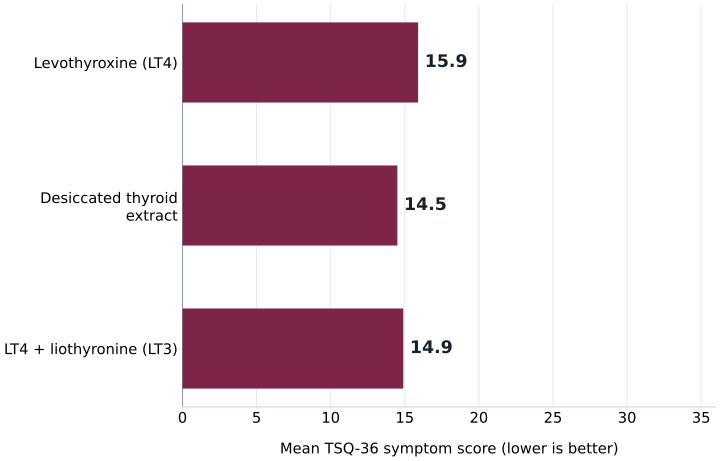
Study facts at a glance
Participants: Ninety people enrolled; 15 withdrew before randomization because of relocation or scheduling conflicts, and 75 completed the trial. Source 1
Duration: Each participant received three treatments for 22 weeks each: approximately 66 weeks of treatment, not 22 weeks total. Source 1
Overall symptom result: Mean TSQ-36 scores were 15.9 with levothyroxine, 14.5 with desiccated thyroid extract, and 14.9 with combination therapy; the overall comparison was not significant, P=0.357. Source 1
Exploratory signal: The highest-symptom TSQ-36 group contained 20 participants. Its findings were secondary subgroup results, not a powered primary demonstration of benefit. Source 1
Safety and regulation: No adverse effects were reported, but heart rate was higher during desiccated thyroid treatment. FDA currently states that animal-derived thyroid products are not FDA approved. Source 1 Source 4
The study followed treated adults, not everyone with abnormal thyroid tests
The participants were military health system beneficiaries with primary hypothyroidism—underactivity originating in the thyroid gland—and stable replacement treatment. Eligibility specified a stable levothyroxine dose for at least six months, although the baseline medication table included some participants taking desiccated thyroid or combination therapy. Actual ages ranged from 29 to 65, with an average of 50. Women accounted for 77.3% of participants; the same proportion were White.
The causes of hypothyroidism included Hashimoto disease in 46 people, thyroidectomy in 16, prior radioactive iodine treatment in four, and an unidentified cause in nine. These were people already receiving hormone replacement, not an untreated population with mildly elevated thyroid-stimulating hormone, or TSH. TSH is the pituitary signal used to help assess replacement adequacy in primary hypothyroidism.
Selection also narrowed the safety question. The study excluded pregnancy, cardiac disease, significant kidney or liver dysfunction, malabsorption disorders, and several other illnesses or medications. Consequently, its findings describe a selected group of relatively stable adults. They do not directly characterize older adults with heart disease or people whose absorption and medication interactions complicate treatment.
Read the underlying chart data: download CSV or download the source-labeled chart.
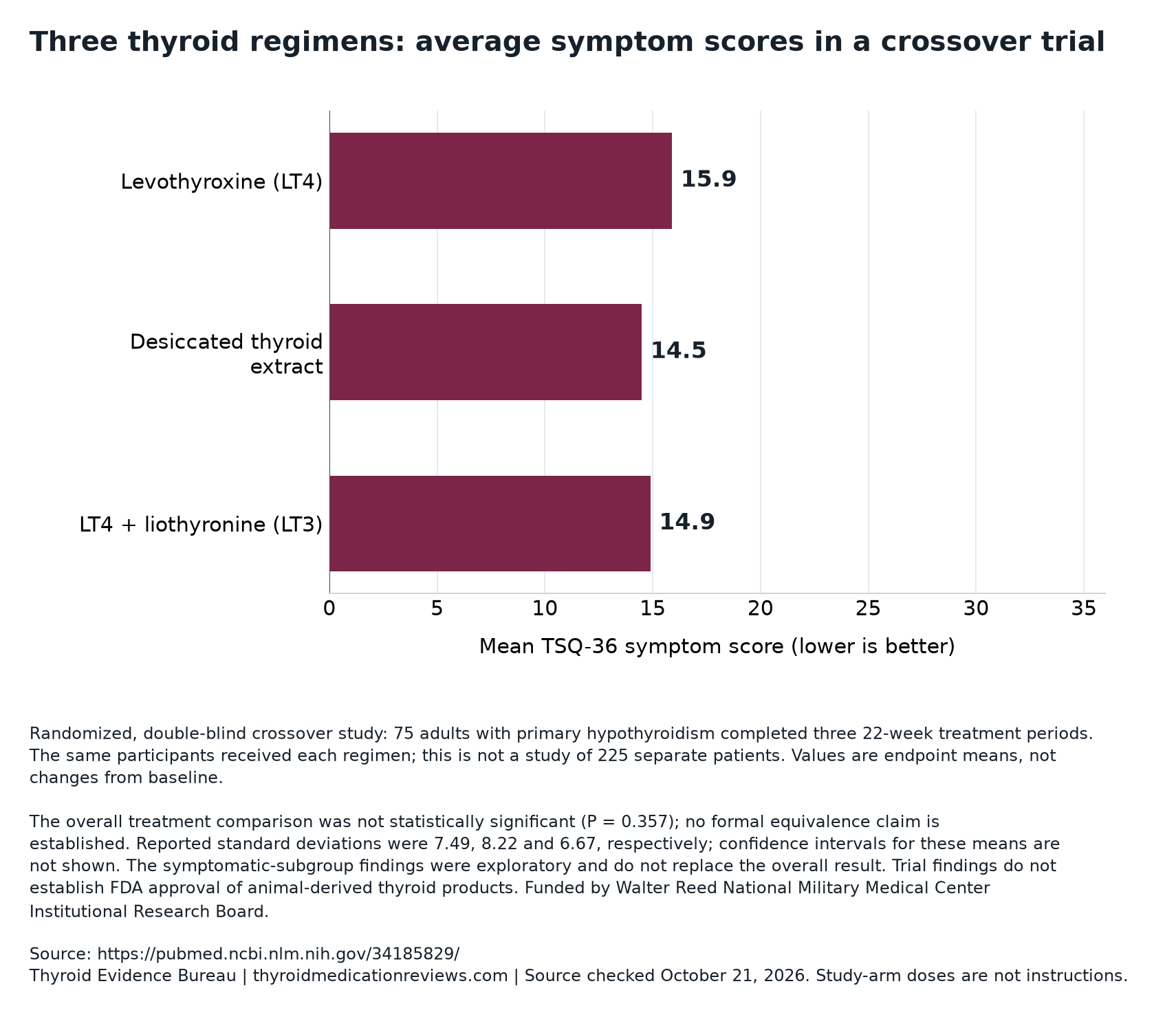
Three treatment periods made each person their own comparator
The randomized, double-blind crossover design gave each participant all three oral treatments in a randomized sequence. Levothyroxine, abbreviated LT4, supplies T4. Liothyronine, or LT3, supplies T3. Desiccated thyroid extract, or DTE, is animal-derived and contains both hormones. The research pharmacy placed the study products in identical capsules; participants, evaluating investigators, cognitive testers, and analysts remained blinded.
Each period lasted 22 weeks. Investigators checked TSH after six weeks and used protocol-defined adjustments to keep it within the study reference range of 0.27–4.20. Participants then continued for another 16 weeks before crossing to the next treatment. The three periods therefore amounted to roughly 66 weeks. Study medicines were administered once daily in the morning; that detail describes the experiment, not a regimen recommendation.
A crossover reduces the problem of comparing fundamentally different people: a participant’s score on one treatment can be compared with that same participant’s score on another. The mixed-effects analysis accounted for repeated observations within individuals. Nevertheless, 75 people receiving three treatments are still 75 independent participants, not 225. For broader category distinctions, the T4, T3, and desiccated thyroid guide provides background separate from this trial’s findings.
The main outcomes did not identify an overall winner
The primary outcomes covered thyroid symptoms, general psychological well-being, depressive symptoms, and memory. They included the TSQ-36 thyroid symptom questionnaire, GHQ-12 general health questionnaire, Beck Depression Inventory, and five Wechsler memory domains. The investigators developed the thyroid questionnaire from earlier instruments; its 12 questions asked participants about their experience over the preceding treatment period.
Across the complete group, none of these primary comparisons showed a statistically significant treatment difference. The thyroid symptom means favored DTE numerically by 1.4 points and combination therapy by 1.0 point relative to LT4, but the overall P value was 0.357. A numerical ordering alone does not establish superiority, especially when scores vary substantially among participants.
General health and depression scores were also close, and none of the five memory domains separated the treatments statistically. Weight, cholesterol measures, and other reported metabolic markers likewise showed no significant overall treatment differences. This matters because a claim of broad improvement in mood, cognition, and metabolism would extend well beyond the actual whole-group findings.
Selected whole-group outcomes. Values are means with standard deviations, not confidence intervals; P values compare all three treatments.
| Measure | LT4 / DTE / LT4+LT3 | Overall comparison |
|---|---|---|
| TSQ-36 symptoms | 15.9 (7.49) / 14.5 (8.22) / 14.9 (6.67) | P=0.357; no significant difference |
| GHQ-12 general health | 11.9 (5.13) / 11.7 (6.16) / 11.6 (4.83) | P=0.891; no significant difference |
| Beck Depression Inventory | 7.15 (7.11) / 7.09 (8.55) / 7.33 (7.67) | P=0.947; no significant difference |
| Visual memory index | 80.4 (12.1) / 79.8 (8.06) / 81.0 (11.3) | P=0.518; no significant difference |
| Resting heart rate, beats/minute | 71.5 (11.1) / 73.7 (14.3) / 70.4 (14.6) | P=0.04; higher during DTE |
A nonsignificant comparison is not proof of equivalence
The trial was sized to detect an eight-point within-person difference on a thyroid symptom measure, using assumptions drawn from earlier research. Investigators estimated that 67 participants would provide 80% statistical power and planned 90 enrollees to allow for withdrawals. That planning supports interpreting the study as a search for treatment differences of a specified size, not as a formal equivalence trial.
Equivalence requires a prespecified boundary defining how different treatments may be while still counting as clinically equivalent, followed by an analysis showing sufficient precision within that boundary. This study did not establish such a margin. Its nonsignificant results therefore support no demonstrated overall superiority, rather than proof that smaller differences are absent.
The distinction between standard deviations and confidence intervals is equally important. A standard deviation describes how spread out participants’ scores were. A confidence interval describes uncertainty in an estimated treatment effect. The outcome table reports the former; treating those parentheses as confidence intervals would misstate the precision. The review-quality guide explains why this distinction matters when assessing comparative claims.
The symptom subgroup produced a narrower, uneven signal
For exploratory analyses, investigators ranked participants using scores obtained during their LT4 period and divided them into low, medium, and high groups. The groups were constructed separately for different measures. Although described as terciles, the thyroid symptom categories contained 30, 25, and 20 participants—not three equal groups of 25. The highest TSQ-36 group was therefore a small subset.
Those with the worst thyroid symptom scores on LT4 showed greater improvement with both combination therapy and DTE than the less symptomatic groups. Depression-score analyses showed a similar pattern. For general health, however, the distinction between treatments matters: the DTE subgroup changes were numerically favorable but not statistically significant. It would be inaccurate to say both alternatives significantly improved every questionnaire.
Memory findings were also selective. Participants with the poorest visual memory scores showed improvement with T3-containing treatments, but visual working memory and immediate memory did not show significant tercile differences. Nor did the subgroup analyses uncover favorable metabolic responses. These findings support a targeted research hypothesis about persistent symptoms, not a universal cognitive or metabolic advantage. The persistent-symptoms guide offers a framework for documenting the broader clinical question.
Why the subgroup needs a purpose-built confirmation trial
Selecting people because they scored poorly during one condition creates a statistical challenge: an unusually bad score may be less extreme when measured again, even without a treatment-specific benefit. This is regression to the mean. Here, LT4-period scores both defined the groups and served as the reference for change under the other treatments, making that possibility especially relevant.
The authors acknowledged this explanation but argued that agreement across several measures and treatment preferences made it less likely to explain everything. That is a reasonable hypothesis, not a decisive test. Related questionnaires were highly correlated, so similar patterns across them are not equivalent to several independent replications.
The analyses also involved many outcomes and comparisons. Some pairwise comparisons received statistical adjustments, but no overall multiplicity correction covered the full collection of exploratory subgroup tests. More testing creates more opportunities for chance findings. A stronger next study would recruit persistently symptomatic participants in advance, define the main outcome and subgroup criteria before treatment, and have adequate power for that specific question.
Blood hormone changes did not establish a brain mechanism
Treatment clearly changed circulating hormone patterns. Mean predose total T3 was 103 ng/dL during LT4, 155 during DTE, and 132 during combination therapy. Total and free T4 were lower during the T3-containing treatments. Mean TSH remained within the reference range, although it was higher during DTE: 2.34 compared with 1.63 on LT4 and 1.76 on combination therapy.
These samples were collected fasting before the morning dose. They do not describe the full daily exposure pattern, particularly for shorter-acting T3. A higher predose concentration cannot by itself reveal hormone levels inside brain cells, the timing of postdose peaks, or whether a particular tissue received more appropriate signaling.
The authors proposed that incomplete restoration of brain thyroid signaling might explain some persistent symptoms. However, the study found no correlation between serum T3 and outcomes, including in subgroup analyses. It also did not identify a reliable treatment-response pattern based on disease cause or the Thr92Ala-DIO2 genetic variant; the homozygous variant group was small. The biological explanation remains a hypothesis, not an established causal finding or validated selection test.
Preference and tolerability answered different questions
At the end, participants ranked the blinded treatments. DTE received the largest number of first-place entries, followed by combination therapy and LT4, but the preference comparison was not statistically significant. Several participants gave tied rankings or expressed no preference. Consequently, the table should not be converted into a simple claim that a fixed majority definitively preferred one alternative.
Investigators specifically asked about palpitations, tremor, sweating, and other symptoms. The report states that no adverse effects occurred and no participant withdrew because of side effects. Yet measured resting heart rate was modestly higher during DTE: 73.7 beats per minute versus 71.5 on LT4 and 70.4 on combination therapy, with an overall P value of 0.04. Blood pressure did not differ significantly.
The safety interpretation is bounded by size, selection, and exposure: each treatment was studied for 22 weeks in people without known cardiac disease. The trial cannot establish long-term cardiovascular or skeletal safety. Official Synthroid labeling separately identifies arrhythmias and bone loss among overtreatment concerns. Research funding came from the Walter Reed National Military Medical Center Institutional Research Board; one author disclosed consulting relationships, while the others reported no competing financial interests.
TRUST studied a different decision in a different population
The TRUST trial is sometimes drawn into the same discussion, but it asked whether adding LT4 helped older adults with persistent subclinical hypothyroidism: elevated TSH with normal free T4. Its 737 participants were at least 65, averaging 74.4 years, and were randomized to LT4 or placebo in parallel groups. It did not compare three replacement formulations in established treated hypothyroidism.
At one year, the reported between-group difference in hypothyroid symptom change was 0.0 points, with a 95% confidence interval from −2.0 to 2.1. The tiredness difference was 0.4 points, with an interval from −2.1 to 2.9. Both scales ranged from 0 to 100; the prespecified minimum clinically important difference was nine points. Those intervals help rule out an average benefit as large as that threshold for these outcomes in this population.
TSH decreased more with LT4, but patient-reported primary outcomes did not improve. TRUST reported no significant excess of prespecified serious adverse events of special interest and was funded by European Union FP7 and others. This comparison uses its indexed primary report abstract, not an examination of all full-text protocols or supplements. The TRUST analysis develops its implications without treating it as evidence for withdrawing established replacement.
The two trials address different clinical questions.
| Design feature | 2021 three-treatment crossover | TRUST |
|---|---|---|
| Population | 75 treated adults with primary hypothyroidism; ages 29–65 | 737 adults aged 65 or older with persistent subclinical hypothyroidism |
| Comparison | Oral LT4, DTE, and LT4+LT3 in the same participants | Oral LT4 versus placebo in separate randomized groups |
| Main timing | 22 weeks per treatment; approximately 66 weeks total | Primary symptom outcomes at one year |
| Main interpretation | No overall primary-outcome superiority; exploratory symptom signals | Lower TSH without improvement in primary symptom or tiredness scores |
A trial result is separate from product approval and service terms
The historical trial does not confer FDA approval on DTE. FDA currently states that animal-derived thyroid medications are unapproved, identifies concerns about potency, purity, variable hormone levels, and impurities, and describes a risk-based enforcement approach. The agency plans guidance on compliance priorities and product development; that is not a blanket withdrawal deadline. FDA also states these biological products are not eligible for compounding.
FDA-approved synthetic levothyroxine and liothyronine options exist. The crossover findings remain specific to the products, oral administration, monitoring, and selected participants studied; they do not automatically validate other formulations, compounded products, or a service advertising individualized care. The Synthroid label, meanwhile, explicitly warns against using thyroid hormone for obesity or weight loss.
Editorial interpretation: clinical evidence and purchasing documents should be evaluated separately. A price-quote checklist can help organize what a service charges without implying the trial measured costs. Readers considering public service descriptions can consult the CoreAge Rx review or Sesame review to check documentary terms. Those links do not establish availability of a studied product, condition-specific care, or comparable outcomes.
Questions about the evidence
Did this trial prove that adding T3 works better for persistent symptoms?
No. It found no overall primary-outcome superiority. Exploratory analyses suggested that some participants with worse scores during LT4 improved on T3-containing treatments. Because those groups were small, defined using LT4-period scores, and examined through many tests, the result needs confirmation in a trial designed primarily around persistent symptoms.
Does a normal TSH mean the treatments produced identical hormone exposure?
No. Mean TSH remained within the reference range, but T3 and T4 concentrations differed substantially among treatments. Moreover, predose blood sampling did not capture the entire day. The trial demonstrates different blood hormone patterns without establishing that any particular pattern restored brain signaling more effectively.
Why not interpret the higher DTE preference as the main result?
Preference was a secondary outcome, and its overall treatment comparison was not statistically significant. Ties and no-preference responses also complicate a simple head count. Preference is meaningful information about experience, but it does not replace the prespecified symptom and cognitive comparisons or establish long-term benefit.
Did the absence of reported adverse effects establish long-term safety?
No. The study observed 75 selected adults for 22 weeks on each treatment and excluded cardiac disease. It reported no adverse effects, while also detecting a modest heart-rate increase during DTE. Rare events and effects developing over years require larger, longer studies; overtreatment risks remain relevant.
Can TRUST be used to argue that established thyroid replacement is unnecessary?
No. TRUST tested treatment initiation against placebo in older adults with persistent subclinical disease and normal free T4. The crossover trial compared replacement treatments in established primary hypothyroidism. Different populations and comparators prevent using TRUST’s symptom findings as evidence for withdrawing necessary replacement after thyroid failure or thyroidectomy.
What this evidence supports
The strongest conclusion is that this blinded within-person comparison did not demonstrate overall superiority of DTE or LT4+LT3 over LT4 on its primary outcomes. Its main contribution is the combination of that negative overall result with an exploratory signal among participants scoring poorly on LT4. The signal deserves prospective testing, not dismissal—but it is not yet a validated rule for selecting treatment. A persuasive confirmation would identify symptomatic participants before randomization, prespecify clinically meaningful outcomes, control the main comparisons, and assess safety over longer exposure. Product regulation and service contracts remain separate questions from comparative efficacy.
Research access and limitations
The crossover analysis uses the open-access primary article and indexed abstract. TRUST is assessed from its indexed primary report abstract; its full protocols and supplements were not examined. Official DailyMed prescribing information and FDA material supply safety and regulatory context, not additional randomized comparative results. No individual dose conversion, treatment change, or provider outcome is inferred.